
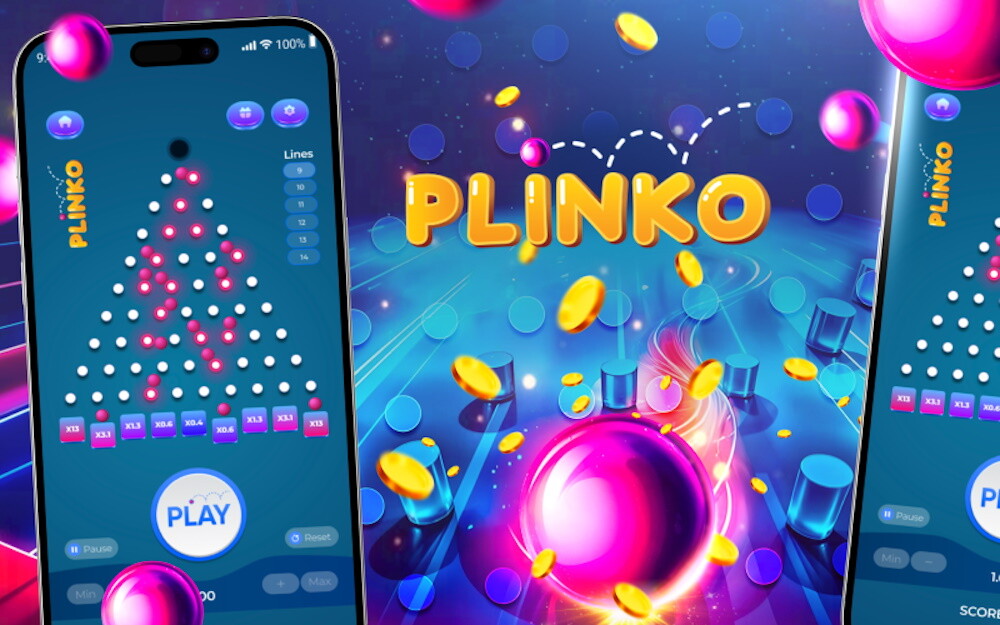
Plinko is a straightforward, simple game to understand and play. A ball drops through a pyramid of pegs, bounces left and right, and lands in a slot with a payout multiplier. Visually appealing, it looks safe and honest. However, how can players know an online game’s result has not been manipulated behind the scenes? With provably fair games, the answer lies in cryptography. Instead of relying entirely on the casino’s assurances, players can use published information to reproduce a result and check whether the ball followed the path determined by the game’s algorithm.
Of course, this is not available everywhere and requires a specialized crypto platform for a casino to be as trustworthy as possible. The process revolves around a server seed, a client seed, and a nonce. Combined through HMAC-SHA256, these inputs generate the data used to determine the ball’s movements. The operator initially conceals the server seed but publishes its hash before play and creates an outcome that can be checked when the seed is revealed.
With the correct information and verification rules, players can independently audit completed rounds rather than simply trusting the animation on their screens. Want to try it out yourself with a popular title like Plinko? To follow the verification walkthrough below, you need an online Plinko game that publishes its seed pair, since without a revealed server seed there is nothing to recompute.
What Does Provably Fair Mean for Plinko?
Provably fair technology allows players to check whether game outcomes are consistent with predetermined inputs and a published calculation method. It does not require players to access the casino’s private servers or trust an unexplained claim that every result was random. Instead, the operator provides information that can be used to recreate the outcome independently.
In Plinko, the calculation must determine a sequence of left or right decisions. Each decision moves the ball along a different route, and the complete sequence determines its final position. The game then maps that position to the corresponding payout multiplier. A verifier that follows the same algorithm and uses the original inputs should reproduce the same path and landing slot.
An animated ball is not evidence of fairness by itself. A website can imitate the appearance of a legitimate casino without implementing its underlying verification system. Therefore, the value of provably fair technology comes from the ability to check the mathematical process, provided the operator publishes the necessary information and follows the documented algorithm.
Understanding Server Seeds and Hashes
The server seed is a randomly generated secret value created by the operator. It is a 64-character hexadecimal string representing 32 bytes of data. The operator keeps the original seed hidden during play but displays its cryptographic hash before the player places a bet.
A hash acts like a digital fingerprint. Applying SHA-256 to the server seed produces a 256-bit output, normally displayed as 64 hexadecimal characters. Changing even one character of the original seed will ordinarily produce a completely different hash. Finding a different seed that produces the same SHA-256 hash is considered computationally infeasible.
Publishing the hash before play establishes a commitment to the hidden server seed. The operator can keep the seed secret while giving players a value against which to check it later. Once the seed is revealed, anyone can calculate its SHA-256 hash and compare the result with the value recorded before betting.
If the hashes match, the revealed seed matches the original commitment. This is an essential part of the audit, but it does not prove everything on its own. The comparison does not establish that every result was generated correctly, nor does it prove that the operator selected the seed without bias. Players must also reproduce the individual game’s outcome using the committed seed and the other required inputs.
The Client Seed
The client seed is a value the player controls. Many platforms generate a default seed automatically when an account is registered, sometimes using the browser. Players should learn how to view and change this value, particularly before beginning a session they intend to audit.
Including a player controlled input helps prevent the operator from choosing both sides of the seed pair. The server seed comes from the operator, while the client seed gives the player a separate input to the calculation. Together, they contribute to the data used to generate each outcome.
Choosing a client seed does not let players control the ball’s destination or improve their chances of landing in a high multiplier slot. A particular word, number, or string is not a reliable prediction of future results. Its purpose is to provide an input that can be recorded and used to reproduce the game’s calculation.
The client seed must match the value used when the bet was placed, including its exact characters, punctuation, and capitalisation. If the seed changes during a session, the verifier must use the original value associated with the particular round rather than the player’s current setting.
The Nonce
The nonce is a counter that advances with each bet made under the relevant seed pair. It allows the system to generate different results without changing either seed after every round. Depending on the implementation, the first nonce might be zero or another starting value, so players should use the number recorded for their actual bet.
For example, three consecutive bets might use nonces 0, 1 and 2. Even with the same server and client seeds, each nonce produces a different HMAC input and therefore a different output. The nonce identifies the position of a particular bet within the sequence.
This is why knowing the seeds alone is insufficient. A verifier using the correct seeds but the wrong nonce will generally generate a different path. When auditing a round, players should preserve the exact nonce alongside the client seed, the original server seed hash, and the displayed result.
HMAC-SHA256 Generates the Result
The cryptographic function behind this process is HMAC-SHA256. It combines a secret key with message data to generate a fixed length output. The server seed acts as the HMAC key, while the message incorporates the client seed, nonce, and cursor information.
Each HMAC-SHA256 output contains 32 bytes. Under the described conversion method, four bytes are consumed for each random value, meaning one output can supply eight values. If a game needs more than eight values, the generator obtains additional output using the cursor mechanism.
The cursor tracks which portion of the generated data the game needs next. It is not another seed selected by the player, but an indexing mechanism that allows the algorithm to obtain enough values to finish its calculation. The exact cursor progression depends on the game’s implementation, so a verifier must follow the published rules for the specific version being audited.
Plinko requires multiple decisions to determine the ball’s final destination. On a 16 row board, the ball makes 16 left or right decisions. Eight four byte values from a single 32 byte HMAC output are not sufficient for all 16 decisions, so additional values must be generated. With four cursor increments for Plinko, cursor handling must match the actual algorithm. Assuming that every game uses the same sequence can produce an incorrect verification result.
Once the necessary values are available, the game converts them into directional decisions. Those decisions determine the ball’s route through the board, while the payout table associates its final slot with a multiplier. The animation displays that route, but the underlying cryptographic calculation is what allows players to reconstruct it independently.
How to Verify it Yourself
The verification process is straightforward when the platform provides the necessary information. First, record the server seed hash displayed before placing a bet. This is the commitment against which the original server seed will be checked. Keep the client seed and nonce associated with the round, and record the landing slot so that the reconstructed result can be compared with the original.
Second, play the round and retain its details. When finished with the relevant seed sequence, use the platform’s seed rotation feature to replace the active server seed. The previous server seed should then be revealed, allowing completed rounds associated with it to be checked.
Next, apply SHA-256 to the revealed server seed. Compare the resulting hash with the value recorded before play. If they match, the revealed seed matches the original commitment. If they differ, check that the seed was copied correctly and that the correct original hash was used before treating the discrepancy as evidence of a problem.
Then reproduce the outcome using a verifier that implements the same Plinko algorithm. Enter the revealed server seed, the original client seed, and the correct nonce. The verifier must apply HMAC-SHA256, handle the cursor correctly, and reproduce the sequence of left or right decisions.
Compare the reconstructed path and landing slot with the recorded game. If the commitment matches and the calculation reproduces the original result, the player has independently checked that the outcome is consistent with the published process.
If the result does not match, check for common errors first. An incorrect nonce, an outdated client seed, a transcription mistake, or a verifier using different algorithm rules can all produce discrepancies. If the information is correct and the mismatch persists, the player has a specific result to investigate with the operator.
Stake Plinko provides a practical starting point for readers who want to understand the process from beginning to end. Its published documentation explains the seed system, HMAC-SHA256, and the game’s verification mechanics. The platform’s verification guidance also explains how to check supported game results.
The essential process is to record the original server seed hash, reveal the seed after rotation, confirm that its hash matches the original commitment, and reproduce the result using the correct client seed, nonce, and algorithm. When these steps can be completed independently, players have meaningful evidence that a Plinko drop is consistent with the published system.
Fake Plinko Apps
Plinko’s familiar format has also been used to attract users to fraudulent applications and websites. In September 2024, Albania’s State Police issued a public warning concerning a fake application advertised as “PLINKO.” The warning described social media promotions using videos of well known people to make the offer appear credible. Users were asked to provide bank account details, so authorities warned that the information could be exploited to withdraw money from those accounts.
A convincing interface should never be mistaken for proof of legitimacy. An application can copy the appearance of a popular casino game without providing the same underlying technology, transparency, or consumer protections. Claims of effortless earnings are particularly poor evidence that a platform is trustworthy.
For a game claiming to use seed based provable fairness, the availability of a server seed commitment is a useful initial check. If the platform does not publish a hash before play or reveal the corresponding server seed afterward, the verification procedure described in this guide cannot be completed. Without the original commitment, players cannot perform the essential comparison between the published hash and the revealed seed.
That absence does not automatically prove fraud. Some games use other documented fairness mechanisms or independently tested random number generators. However, a platform advertising seed based provable fairness should explain its implementation and provide the information needed to verify its results. Check the operator’s identity, regulatory status, privacy practices, and withdrawal terms. A fraudulent website can imitate a legitimate game’s branding, but it cannot inherit the original operator’s verification system simply by copying its design.
What Provable Fairness Does Not Guarantee
Provably fair verification is a transparency mechanism, not a winning strategy. It helps establish whether a result is consistent with the committed inputs and published algorithm. It does not eliminate the house edge, make a losing result less likely, or predict future outcomes.
Changing the client seed does not guarantee a better landing slot, and checking previous results does not reveal a reliable pattern for future drops. Once the server seed is revealed, past results can be reconstructed, but that information does not provide a practical method for predicting outcomes generated using a new, hidden seed.
The house edge remains a separate mathematical property. Stake advertises a 99% return to player and a 1% house edge for its Plinko configuration. These figures describe theoretical long run expectations, not a guarantee that an individual player will recover 99% of their wagers. Actual results can vary significantly over shorter periods. A correctly generated result can still produce a loss, just as a fair game can produce a substantial win.